Thinking of an EASA licence? The real key to ATPL success
Question banks are useful for practice, but they should support learning — not replace it. Why the EASA Learning Objectives are the foundation of passing the exams and of becoming a good pilot.
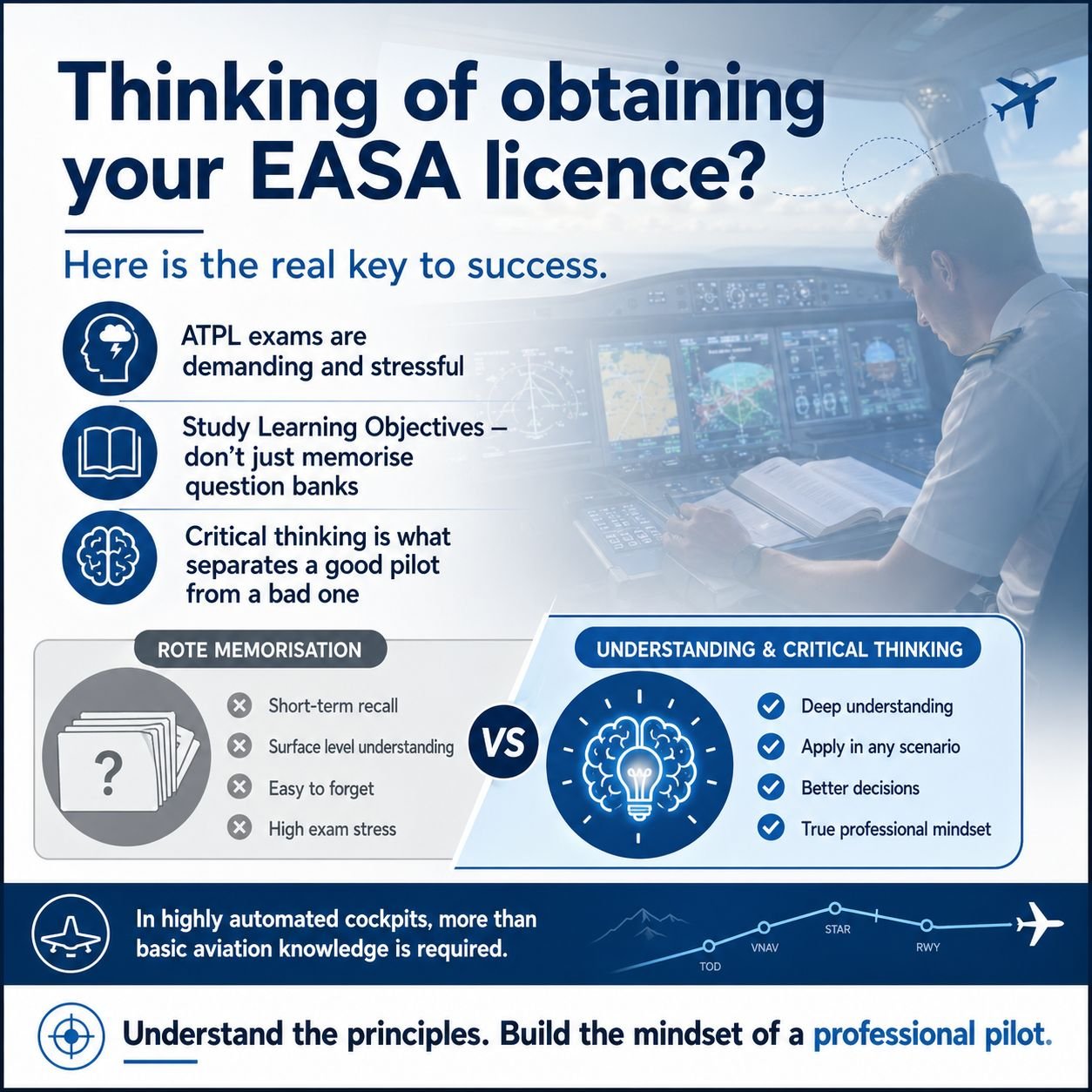
The EASA ATPL theoretical knowledge exams are demanding, time-consuming and stressful. Thirteen subjects, a 75% pass mark in each, and a fixed time window to complete them all. It's no surprise that many students look for the fastest route: memorise as many questions as possible.
That approach can produce exam passes. It rarely produces understanding — and understanding is what the rest of your career will test.
What the Learning Objectives are
For each subject, EASA publishes detailed Learning Objectives (LOs) as part of the Part-FCL theoretical knowledge syllabus. Each LO describes something you should be able to explain, describe, calculate or apply — for example, how a particular instrument works, or how to calculate a weight-and-balance problem.
The exams are written to test those objectives. That means:
- The LOs are the real syllabus. If you can do what each LO asks, you can answer questions you have never seen before.
- Question wording changes; principles don't. A memorised answer fails as soon as the question is rephrased or the numbers change.
Two ways to study
| Rote memorisation | Understanding |
|---|---|
| Short-term recall | Deep, long-term knowledge |
| Breaks down when the question changes | Applies to new situations |
| Little use in the cockpit or interview | Builds judgement and better decisions |
| High stress before each exam | Confidence that grows with each subject |
Why it matters beyond the exam
The difference between an average pilot and a good one shows when things are not exactly as expected: a system behaves strangely, the weather is worse than forecast, a clearance doesn't make sense. Handling those moments needs pilots who understand what is happening, can question what they see, and know when to intervene.
That is even more true in highly automated cockpits. Monitoring automation well requires knowing what it should be doing — and recognising when it isn't.
Operators know this too. During interviews, simulator assessments and type rating training, it quickly becomes clear who understood the concepts and who memorised answers.
A practical study method
- Start each topic from the LOs, not from the question bank. Read them, then study the material until you could teach each one.
- Explain it out loud. If you can't explain a concept simply, you don't understand it yet.
- Use the question bank as a diagnostic. After studying, practise questions to find gaps — then go back to the LOs for anything you got wrong or guessed right.
- Link subjects together. Meteorology connects to performance and flight planning; instruments connect to human performance and operational procedures.
- Plan your sittings realistically. Group related subjects and leave time for revision before each sitting.
Check yourself
Knowledge check
Planning your ATPL studies? See our ATPL coaching and the overview of the exam rules.
Keep learning
Try the free course Human Factors Essentials for Pilots, or create an account to follow new articles.