EASA's new FSTD thinking: from "best simulator" to "right tool for the task"
The update of EASA's flight simulation requirements moves the question from "which device is most advanced?" to "which capability does this training task actually need?" — a natural fit with Evidence-Based Training.
For decades, flight simulation training devices (FSTDs) have been described mainly by level: a Full Flight Simulator Level D sits at the top, flight training devices and FNPTs below it. The level tells you how faithfully the device reproduces the aircraft — and, implicitly, that a higher level is always better.
EASA's work on updating its FSTD requirements (rulemaking task RMT.0196) challenges that assumption. The idea that stands out is a "task-to-tool" approach, supported by a description of what each device can actually do — referred to as the FSTD Capability Signature (FCS).
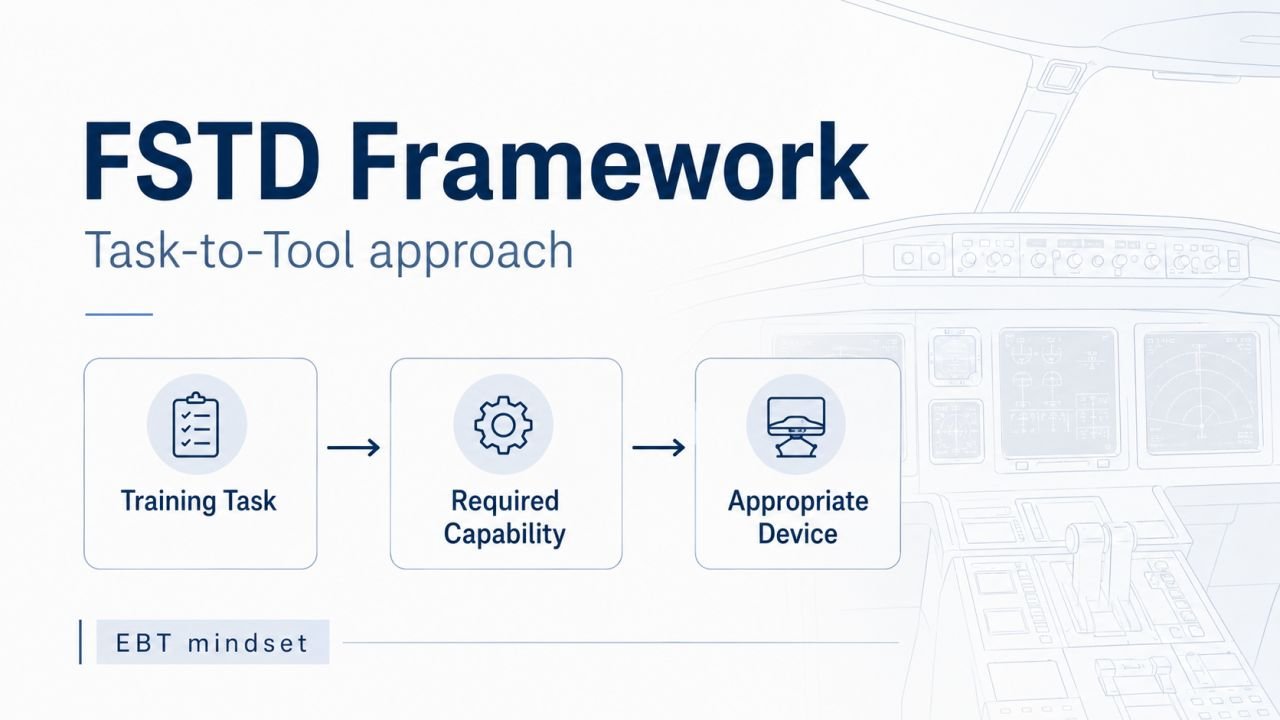
The logic in three steps
- Define the training task. What exactly should the trainee be able to do at the end of the session? Manage a rejected take-off? Practise an instrument approach procedure? Rehearse crew coordination in a non-normal checklist?
- Identify the capability required. Which features matter for that task — motion, visual system, flight model fidelity in a particular regime, sound, cockpit layout, specific systems?
- Select the device whose capabilities match those needs.
Instead of asking "What is the highest-level device available?", the instructor or training organisation asks "What does this task need, and which device provides it?"
Why it fits Evidence-Based Training
Evidence-Based Training (EBT) builds training around competencies — such as situation awareness, workload management, problem solving and communication — and around the real threats seen in operational data. Many EBT scenarios are about decision-making and crew behaviour more than about the last few percent of handling fidelity.
A task-to-tool approach lets an operator match each part of an EBT programme with a suitable device:
| Training objective | What matters most |
|---|---|
| Manual handling in an upset or high-energy situation | Flight model fidelity, motion cues, visual system |
| Managing a complex non-normal checklist as a crew | Accurate systems simulation, cockpit layout |
| Procedures and flows for a new type | Cockpit layout and logic; motion may be unnecessary |
| Decision-making around weather or diversion | Realistic scenario, ATC and environment, not necessarily full motion |
The most advanced simulator is not automatically the best tool for every objective. What matters is whether the device provides the right level of fidelity and capability for the task.
What it means as new technology arrives
Extended reality (XR) headsets, desktop trainers and cloud-based procedures trainers are becoming more capable every year. A capability-based description gives regulators and training organisations a common language to judge where these tools can be credited — and where they cannot.
The principle is worth remembering beyond the regulation itself:
For student pilots
You will meet different devices during your training: FNPTs, FTDs and full flight simulators. Ask your instructor what each session is designed to train and why that device was chosen. Understanding the purpose of a session helps you focus on the competencies being trained instead of on how "real" the device feels.
Further reading
- EASA rulemaking task RMT.0196 — update of flight simulation training device requirements.
- CS-FSTD(A) and CS-FSTD(H) — current certification specifications for aeroplane and helicopter FSTDs.
- ICAO Manual of Evidence-based Training (Doc 9995).
Regulatory texts evolve — always check the current EASA publications for the status of this rulemaking.
Keep learning
Try the free course Human Factors Essentials for Pilots, or create an account to follow new articles.