
ECAM: the system that talks back
Airbus's Electronic Centralised Aircraft Monitor doesn't just tell you something is wrong — it shows the failure and the actions to take. How it works, and why understanding it still matters.
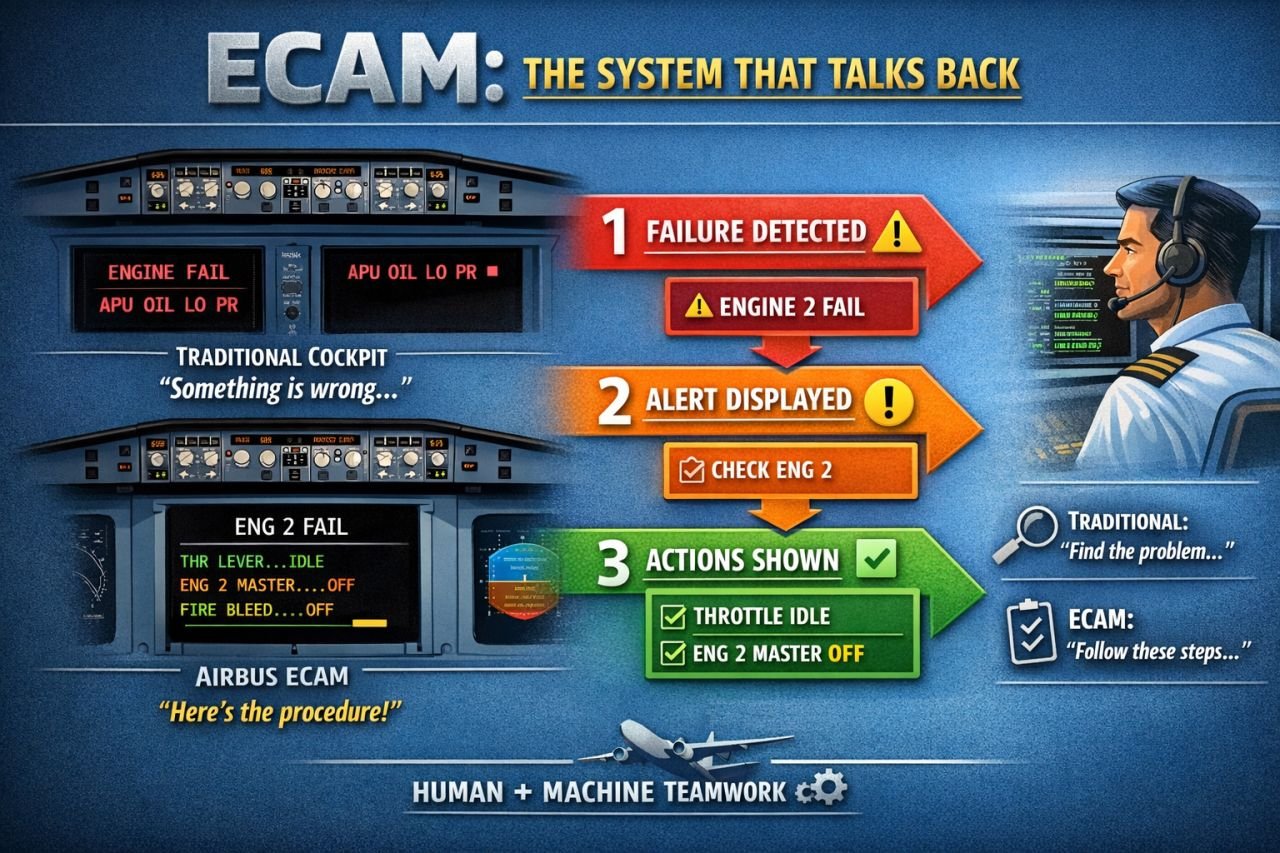
Imagine an aircraft that doesn't just warn you that something is wrong, but tells you what the problem is and what to do next. That is the idea behind ECAM — the Electronic Centralised Aircraft Monitor on Airbus aircraft.
From "find it" to "here it is"
In older cockpits, a failure might show as a warning light, a flag or an unusual gauge reading. The crew had to scan, diagnose and then find the right procedure in a paper checklist.
ECAM changes that sequence:
| Traditional cockpit | Airbus ECAM |
|---|---|
| "Something is wrong — find it." | "Here's the problem. Here's the procedure." |
| Scan dozens of indications | Failure title displayed centrally |
| Look up the checklist | Corrective actions displayed as a list |
| Remember the affected systems | System page shown automatically |
How it works
ECAM continuously monitors the engines and aircraft systems. When it detects a failure it:
- Alerts the crew — with a master warning or master caution and an aural signal, depending on the urgency.
- Displays the failure on the upper display (Engine/Warning Display), together with the actions to perform.
- Shows the relevant system page on the lower display (System Display), so the crew can see the affected system.
- Updates the list as actions are completed, then shows a status page with remaining limitations and inoperative systems.
Alerts are prioritised by urgency:
- Red warnings — immediate action required (e.g. engine fire), with a continuous master warning.
- Amber cautions — awareness and action, but not necessarily immediately.
- Lower-level advisories and memos for information.
Boeing aircraft use a comparable approach with EICAS and electronic checklists. The philosophy differs in detail, but the goal is the same: reduce workload and the chance of error during non-normal situations.
Why understanding still matters
ECAM is a brilliant example of human–machine cooperation, but it is not a substitute for knowledge:
- Crews still have to confirm the failure and decide when to act — "fly the aircraft first".
- Some situations require judgement beyond the displayed procedure (for example, multiple failures, or when the indication itself may be wrong).
- After ECAM actions, the crew must understand the consequences — landing distance, fuel, approach capability — to plan the rest of the flight.
Check yourself
Knowledge check
Keep learning
Try the free course Human Factors Essentials for Pilots, or create an account to follow new articles.