Evidence-Based Training in practice: how operators implement it
EBT sounds powerful in theory. Here is what it looks like inside an operator's training system — from data-driven design to instructor standardisation.
Evidence-Based Training (EBT) shifts pilot training from checking isolated manoeuvres towards developing the competencies that make operations safe. But what does that look like inside a real training department?
The foundations
According to ICAO's Manual of Evidence-based Training (Doc 9995), EBT uses operational data — accident and incident reports, flight data monitoring, line observations such as LOSA, and training data — to identify the threats and errors that matter most. Training is then designed to build and assess the competencies needed to manage them.
In Europe, EASA has introduced EBT into the Air Operations rules (ORO.FC.231 and the associated AMC/GM), allowing operators to replace parts of traditional recurrent training and checking with a competency-based programme.
The competency framework
At the heart of EBT is a set of observable pilot competencies. The ICAO framework includes:
| Competency | In short |
|---|---|
| Application of knowledge | Knows and understands the relevant information |
| Application of procedures and compliance | Applies procedures and regulations appropriately |
| Communication | Communicates clearly in normal and non-normal situations |
| Flight path management — automation | Controls the flight path through automation |
| Flight path management — manual control | Controls the flight path through manual flying |
| Leadership and teamwork | Influences and supports the team |
| Problem solving and decision making | Identifies, assesses and resolves problems |
| Situation awareness and information management | Perceives, understands and anticipates |
| Workload management | Manages resources, priorities and time |
Each competency is described by observable behaviours, which instructors use to assess performance and give feedback.
How operators put it into practice
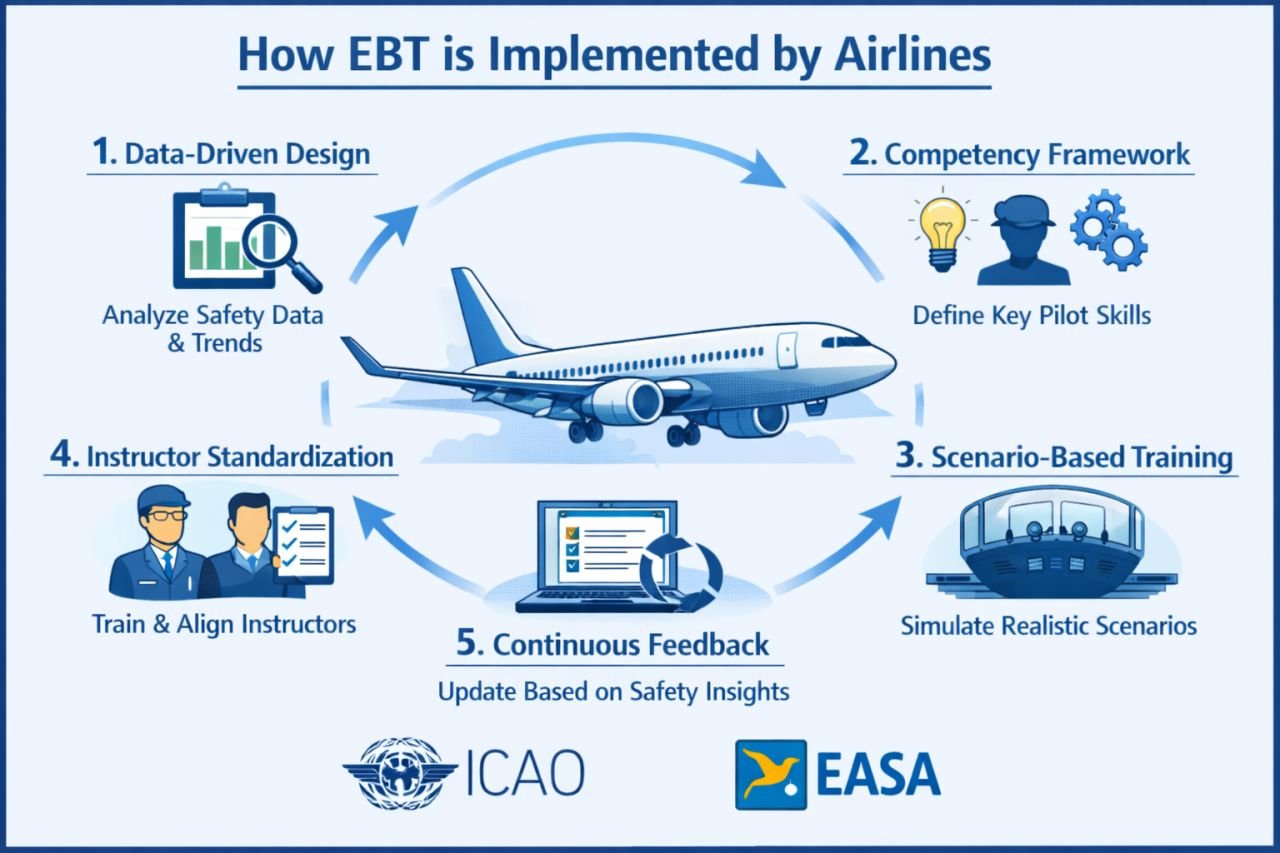
- Data-driven design. Internal and industry safety data define the training priorities for the fleet and the type of operation.
- Competency-based assessment. Instead of "did the pilot fly the manoeuvre within limits?", instructors assess how the crew managed the situation across the competencies.
- Scenario-based simulator sessions. Line-oriented scenarios replicate real operational threats — a weather diversion combined with a technical issue, for example — rather than a list of isolated manoeuvres.
- Instructor standardisation. Instructors are trained to observe behaviours, assess consistently (grading against defined criteria) and run structured, facilitated debriefings.
- Continuous feedback loop. Training results and operational data are reviewed, and the programme evolves with the safety trends.
A typical EBT recurrent session is organised in phases: an evaluation phase (a realistic line scenario to see how the crew performs), manoeuvres training for skills that need repetition, and scenario-based training targeting the competencies that need development.
Check yourself
Knowledge check
Keep learning
Try the free course Human Factors Essentials for Pilots, or create an account to follow new articles.