The navigation paradox — and how a small offset makes oceanic flying safer
The more precisely aircraft navigate, the more likely they are to fly exactly the same invisible line. Strategic Lateral Offset Procedures (SLOP) turn that risk back into a margin.
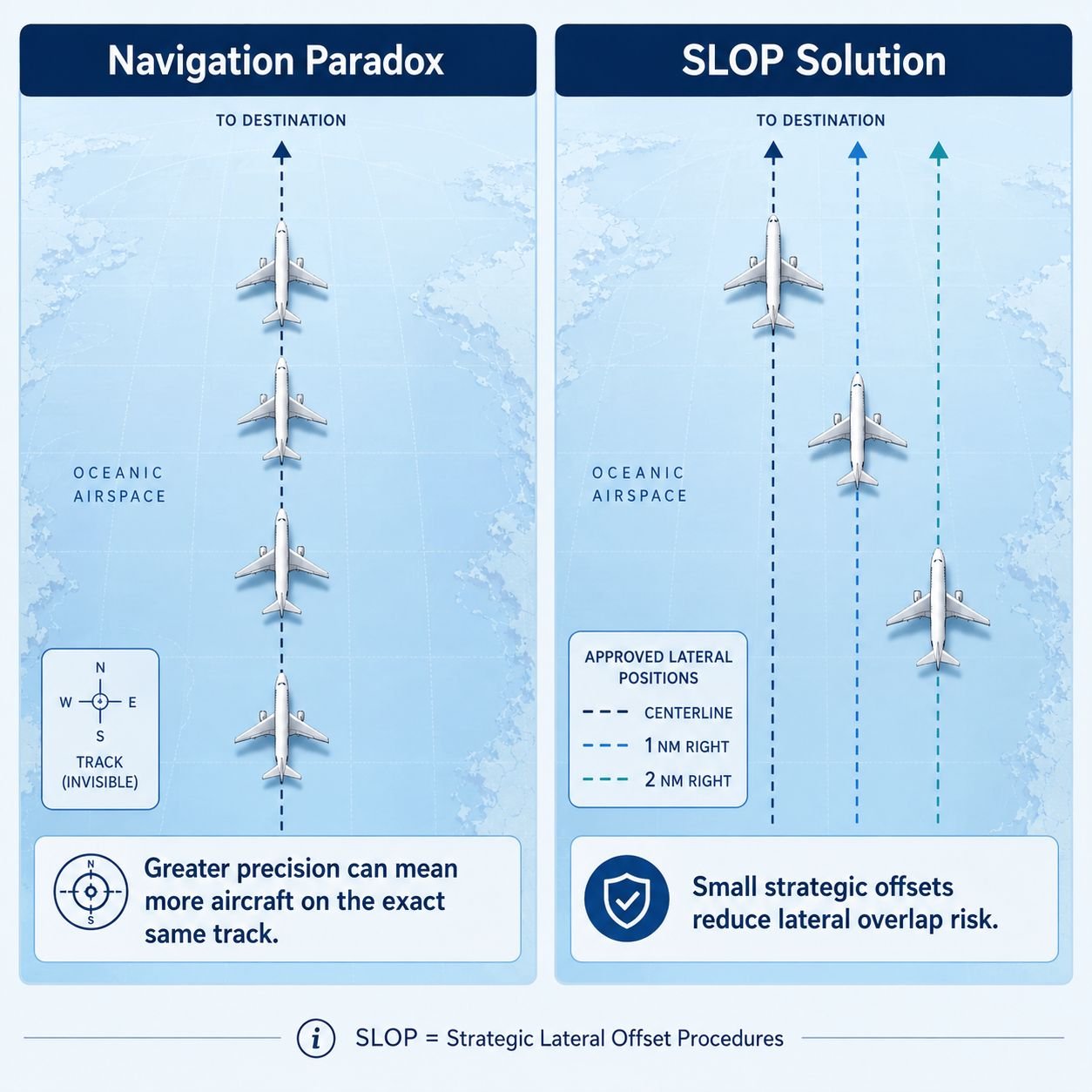
Modern navigation is astonishingly accurate. With GNSS and modern flight management systems, an airliner can follow its cleared route to within a few metres for hours on end.
That is a huge safety improvement — but it has an unexpected side effect known as the navigation paradox:
When every aircraft follows the centreline perfectly, aircraft on the same route are also perfectly aligned with each other.
Why perfect accuracy creates a risk
In oceanic and remote airspace, aircraft on the same track are separated vertically (by flight level) and longitudinally (by time or distance). Lateral position normally isn't the protection — everyone is on the same line.
Now imagine something goes wrong in the vertical dimension:
- an aircraft levels off at the wrong flight level after a misunderstood clearance,
- an altitude-keeping error occurs,
- or turbulence forces an unplanned climb or descent.
In the past, ordinary navigation errors of a mile or two meant that two aircraft at the "same" position were rarely exactly on top of each other. With today's precision, the remaining lateral miss distance can be close to zero. The very accuracy we rely on removes a hidden margin.
The fix: Strategic Lateral Offset Procedures (SLOP)
SLOP lets pilots fly a small, deliberate offset to the right of the cleared track centreline. Under ICAO procedures (PANS-ATM, Doc 4444), offsets are made to the right only, up to a maximum of 2 NM, in airspace where the procedure has been authorised. In many regions, including the North Atlantic, crews may choose the centreline, 1 NM or 2 NM right — and some regions allow smaller increments.
Because different crews choose different offsets, the probability that two aircraft are laterally aligned at the same moment drops dramatically. Offsets to the right only also mean that aircraft flying in opposite directions on the same route are pushed apart rather than together.
| Without SLOP | With SLOP |
|---|---|
| Everyone on the exact centreline | Aircraft spread across centreline, 1 NM and 2 NM right |
| A vertical error can mean a direct overlap | A vertical error usually still leaves lateral spacing |
| Wake turbulence from aircraft ahead lies on your track | An offset can also help avoid wake from aircraft ahead |
Good practice
- Use SLOP only where it is published and authorised — check the AIP and regional documentation.
- Offsets are always to the right and never more than the published maximum.
- Return to the centreline as published (typically before leaving oceanic/remote airspace or when instructed by ATC).
- Don't use the offset to "fix" other problems — it is a strategic risk-reduction tool, not a deviation clearance. Weather deviations follow their own contingency procedures.
Check yourself
Knowledge check
Further reading
- ICAO Doc 4444 (PANS-ATM), section on Strategic Lateral Offset Procedures.
- ICAO North Atlantic Operations and Airspace Manual (NAT Doc 007).
Keep learning
Try the free course Human Factors Essentials for Pilots, or create an account to follow new articles.