From safety reports to simulator scenarios: ECCAIRS 2 and Evidence-Based Training
Thousands of occurrence reports become structured safety intelligence across Europe. Here is how that intelligence can shape more relevant pilot training.
Most pilots train for scenarios. But who decides which scenarios? Ideally, the answer is: real safety data.
What ECCAIRS 2 is
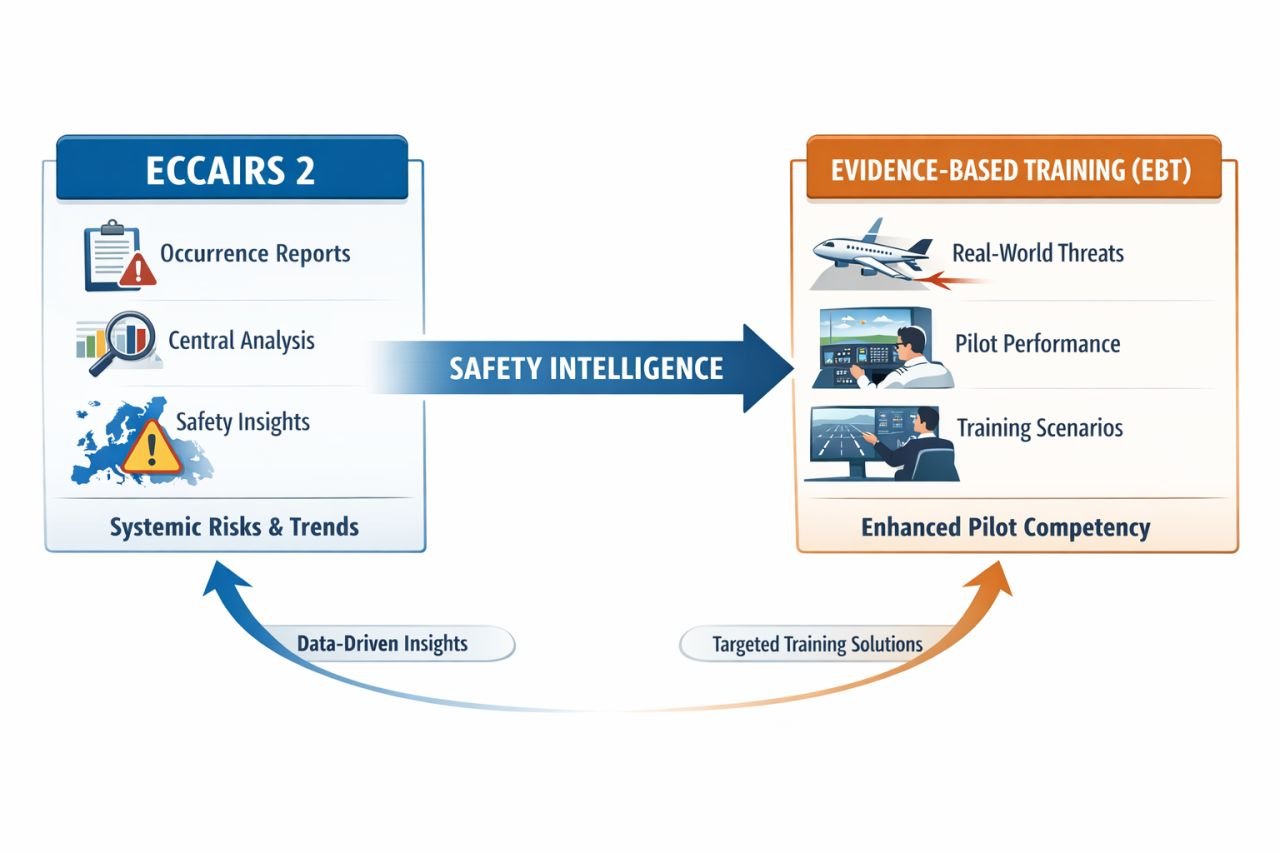
ECCAIRS 2 is the European platform used to collect, standardise and analyse aviation occurrence reports. Under the EU occurrence reporting regulation (Regulation (EU) No 376/2014), organisations and authorities report safety occurrences; the data is stored in a common format and feeds the European Central Repository.
Its value lies in one idea:
It turns thousands of individual reports into structured safety intelligence.
A single report about an unstable approach is an anecdote. Ten thousand reports coded in the same taxonomy reveal trends, systemic risks and emerging threats at a continental level. EASA uses this kind of analysis in its Annual Safety Review and in the European Plan for Aviation Safety.
Where training comes in
Evidence-Based Training (EBT) is built on the same philosophy: train for the threats and errors that actually occur in operations. An EBT programme focuses on:
- real operational threats — weather, system malfunctions, ATC changes, terrain, traffic,
- observed crew errors and how they were (or weren't) managed,
- data-driven priorities — what matters most for this operation.
Connecting the two
Operators do not usually work with raw ECCAIRS data. But they can use the insights derived from it — EASA safety reviews, safety issue analyses and safety promotion material — together with their own data:
| Data source | How it helps training |
|---|---|
| EASA Annual Safety Review and safety issue analyses | Highlights the key risk areas in the operator's type of operation |
| The operator's own occurrence reports | Shows which threats crews actually meet on this network or mission |
| Flight data monitoring (FDM) | Reveals trends such as unstable approaches or exceedances |
| Line observations (e.g. LOSA) | Shows how crews manage threats and errors in normal operations |
With that picture, training designers can:
- align recurrent training with real-world risks,
- build simulator scenarios that reflect the threats crews actually face,
- strengthen Threat and Error Management (TEM) skills where the data shows weaknesses.
For every pilot
Every report you file contributes to this chain. A well-written occurrence report — clear, factual, timely — may end up shaping a scenario that prepares another crew for the same situation.
Further reading
- Regulation (EU) No 376/2014 on occurrence reporting.
- EASA Annual Safety Review (published yearly).
- ICAO Manual of Evidence-based Training (Doc 9995).
Keep learning
Try the free course Human Factors Essentials for Pilots, or create an account to follow new articles.