Safety is not reactive — it is engineered
Every safe operation runs a continuous loop: identify hazards, assess risk, mitigate, monitor and improve. A practical look at how a Safety Management System works day to day.
In aviation, safety is not something that happens after an accident. It is engineered — built into every operation through a structured, data-driven process.
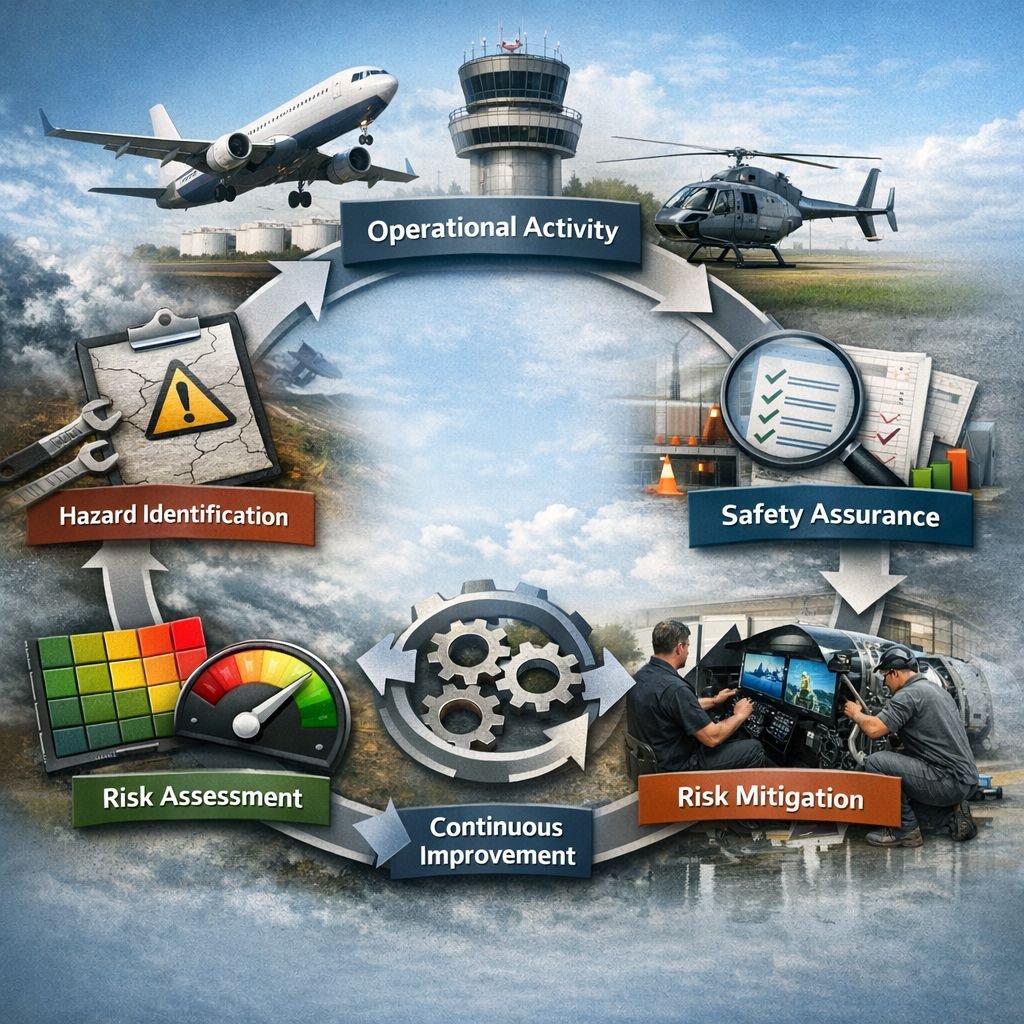
That process is the Safety Management System (SMS). ICAO Annex 19 requires it for operators, training organisations, maintenance organisations and others, and EASA implements it through the management system requirements of each domain. But behind the regulation is a simple idea: a continuous loop.
The loop in practice
- Identify hazards before they escalate. Hazards come from occurrence reports, audits, flight data, crew feedback, changes in the operation — anything that could contribute to an accident.
- Assess the risk. Each hazard is evaluated by severity (how bad could the outcome be?) and probability (how likely is it?). A risk matrix turns that into a priority.
- Implement mitigation. Procedures, training, equipment, scheduling changes — measures that reduce probability, severity or both.
- Monitor performance (safety assurance). Are the mitigations working? Safety performance indicators, audits and data analysis answer that question.
- Continuously improve. The system learns, adjusts and starts the loop again.
A simple example
| Step | Example |
|---|---|
| Hazard | Several reports of unstable approaches at one airport in tailwind conditions |
| Risk | Severity: runway excursion (high). Probability: moderate given current reports |
| Mitigation | Briefing material for that airport, a revised approach technique, a reminder of go-around criteria, a simulator scenario |
| Assurance | Flight data monitoring shows unstable approaches at that airport over the next six months |
| Improvement | If the rate hasn't dropped, the mitigation is reviewed and strengthened |
The four pillars of an SMS
ICAO's framework (Annex 19 and the Safety Management Manual, Doc 9859) describes four components:
- Safety policy and objectives — management commitment, accountabilities, documented goals.
- Safety risk management — the hazard identification and risk assessment described above.
- Safety assurance — monitoring, measuring and managing change.
- Safety promotion — training and communication that build a positive safety culture.
The human part: reporting culture
An SMS is only as good as the information it receives. If people are afraid to report mistakes or near-misses, the system is blind. That's why a just culture — where honest errors can be reported without fear, while reckless behaviour is still addressed — is the foundation of every effective SMS.
Check yourself
Knowledge check
Keep learning
Try the free course Human Factors Essentials for Pilots, or create an account to follow new articles.