Multitasking in the cockpit: a human limitation every pilot must understand
Working memory can only hold a few items at a time. That is why good crews share tasks instead of trying to do everything at once.
Pilots operate in an environment that demands continuous processing of information: instruments, radio calls, checklists, navigation, weather, traffic, the other crew member. It's tempting to believe that good pilots are simply good multitaskers.
Human factors research tells a different story.
How memory works in the cockpit
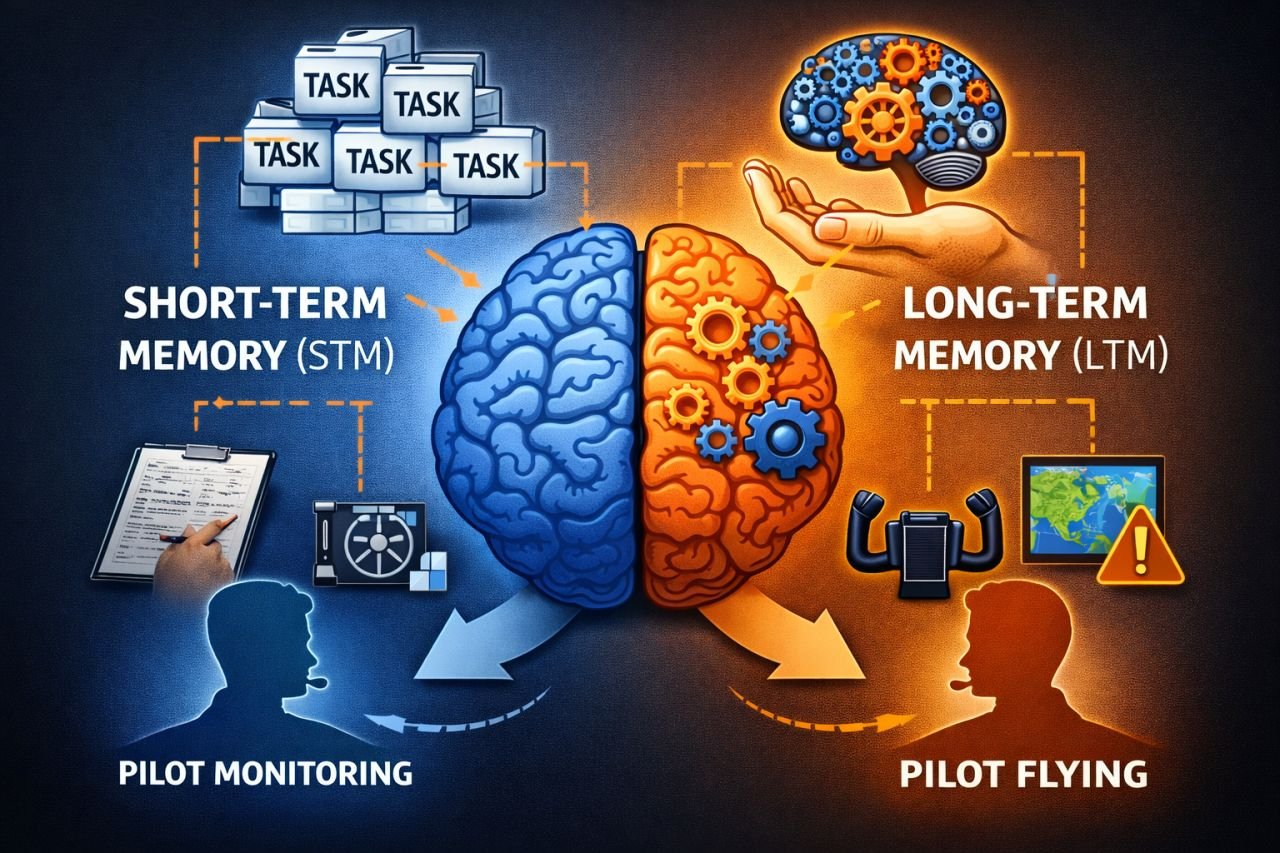
- Short-term (working) memory holds the information you are actively using right now — a clearance, a frequency, a heading. Its capacity is small: classic research suggested around seven items, and more recent work suggests as few as about four "chunks". Without rehearsal, information fades within seconds.
- Long-term memory stores knowledge, procedures and experience. It is large, but retrieving the right item at the right time depends on training and cues.
When too many tasks compete for attention, working memory saturates. The result is predictable:
- missed cues ("I didn't see the caution light"),
- incomplete actions ("I set the altitude but didn't arm the mode"),
- procedural slips ("I was interrupted and skipped an item").
"Multitasking" is really task switching
What we call multitasking is usually rapid switching between tasks. Each switch costs time and accuracy, and the risk of forgetting where you were increases — particularly after an interruption.
Share tasks instead
Crew Resource Management (CRM) and multi-crew procedures exist precisely because one human brain cannot reliably do everything at once. Professional crews:
- divide roles clearly between Pilot Flying (PF) and Pilot Monitoring (PM),
- use standard callouts and flows so information doesn't have to be held in memory,
- rely on checklists, not memory alone, for critical items,
- write things down — clearances, ATIS, fuel figures,
- support each other to keep a shared picture of the situation,
- manage interruptions deliberately: "Hold that thought — I'm completing the checklist."
The same principles apply in single-pilot operations: plan workload ahead, use automation and checklists to offload memory, and protect critical phases from distraction.
Check yourself
Knowledge check
Keep learning
Try the free course Human Factors Essentials for Pilots, or create an account to follow new articles.