The 10-second rule: speak up early in the cockpit
In many events someone in the cockpit noticed the problem — but didn't say it in time. A simple habit that turns a private doubt into shared situational awareness.
Read enough accident and incident reports and a pattern appears: the problem was often noticed by someone on board, but it wasn't said out loud — or it was said too late, too softly, or too indirectly.
A speed a few knots below target. A descent that started a little early. A clearance that didn't quite sound right. Each of these is a small cue on its own, and each is easy to keep to yourself for "just a few more seconds".
The 10-second rule is a practical habit to break that silence:
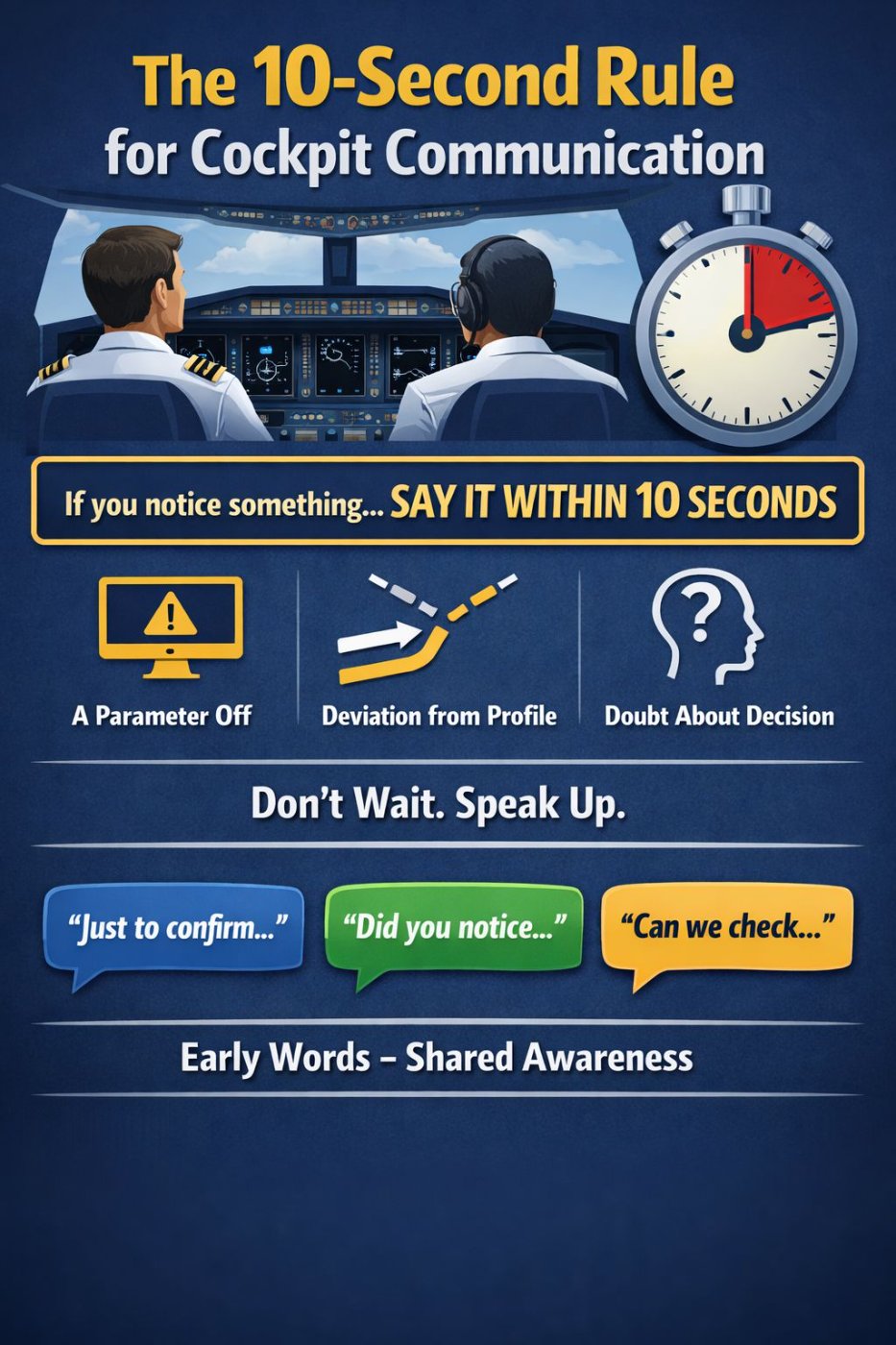
If something catches your attention, say it within 10 seconds.
It isn't a regulation and it isn't a magic number. It is a personal standard that keeps the gap between noticing and saying short — because that gap is where situational awareness starts to split between two pilots.
Why we hesitate
Speaking up seems simple. In practice, several very human factors slow it down:
- Authority gradient. A first officer may hesitate to question a captain; an experienced pilot may hesitate to "bother" a confident trainee — or the other way round.
- The "they must have seen it" assumption. If the other pilot looks relaxed, we assume they have already noticed and decided it's fine.
- Fear of being wrong. Nobody wants to raise a false alarm, especially in front of a trainer or examiner.
- Workload. In a busy phase of flight the thought simply gets pushed aside by the next task.
None of these is a character flaw. They are predictable behaviours — which is exactly why Crew Resource Management (CRM) training gives us tools to manage them.
What to say: low-cost phrases
The trick is to make speaking up cheap. A short, neutral phrase costs nothing if you are wrong and can save a lot if you are right:
| Situation | Phrase |
|---|---|
| A parameter looks off | "Speed checking 5 below." |
| You're not sure of the plan | "Just to confirm — we're cleared to 4,000?" |
| Something doesn't feel right | "Can we check the descent point?" |
| You noticed but aren't sure it matters | "Did you notice the fuel imbalance?" |
Notice that none of these says "you're wrong". They state what you see and invite a cross-check. That keeps the conversation about the aircraft, not about the people.
If the first call isn't heard
Speaking up early is step one. Good crews also agree on what happens if a concern is not acknowledged. Many operators teach a graded approach:
- State the observation — what you see, with the value if you have it.
- Express the concern — why it matters ("we'll be high on the profile").
- Propose an action — "Suggest we go around."
- Insist if the situation is becoming unsafe — and follow your operator's procedures for taking control when required.
The earlier step 1 happens, the less likely you are to ever need step 4.
For captains and instructors: make it easy
The person most able to fix hesitation is the one at the top of the gradient. A briefing line such as "If you see anything you don't like, say it straight away — I'd rather hear it twice than not at all" gives explicit permission. Thanking the other pilot when they do speak up — even when the call turns out to be unnecessary — reinforces the behaviour for the rest of the flight.
Check yourself
Knowledge check
Further reading
- EASA Air Operations rules on Crew Resource Management training (ORO.FC.115 and the associated AMC/GM).
- ICAO Human Factors Training Manual (Doc 9683).
Keep learning
Try the free course Human Factors Essentials for Pilots, or create an account to follow new articles.