Loss of control in flight: the leading helicopter accident category
According to EASA's Annual Safety Review 2025, LOC-I remains the most frequent helicopter accident category over the past five years — and the pattern points to people and energy, not technical failure.
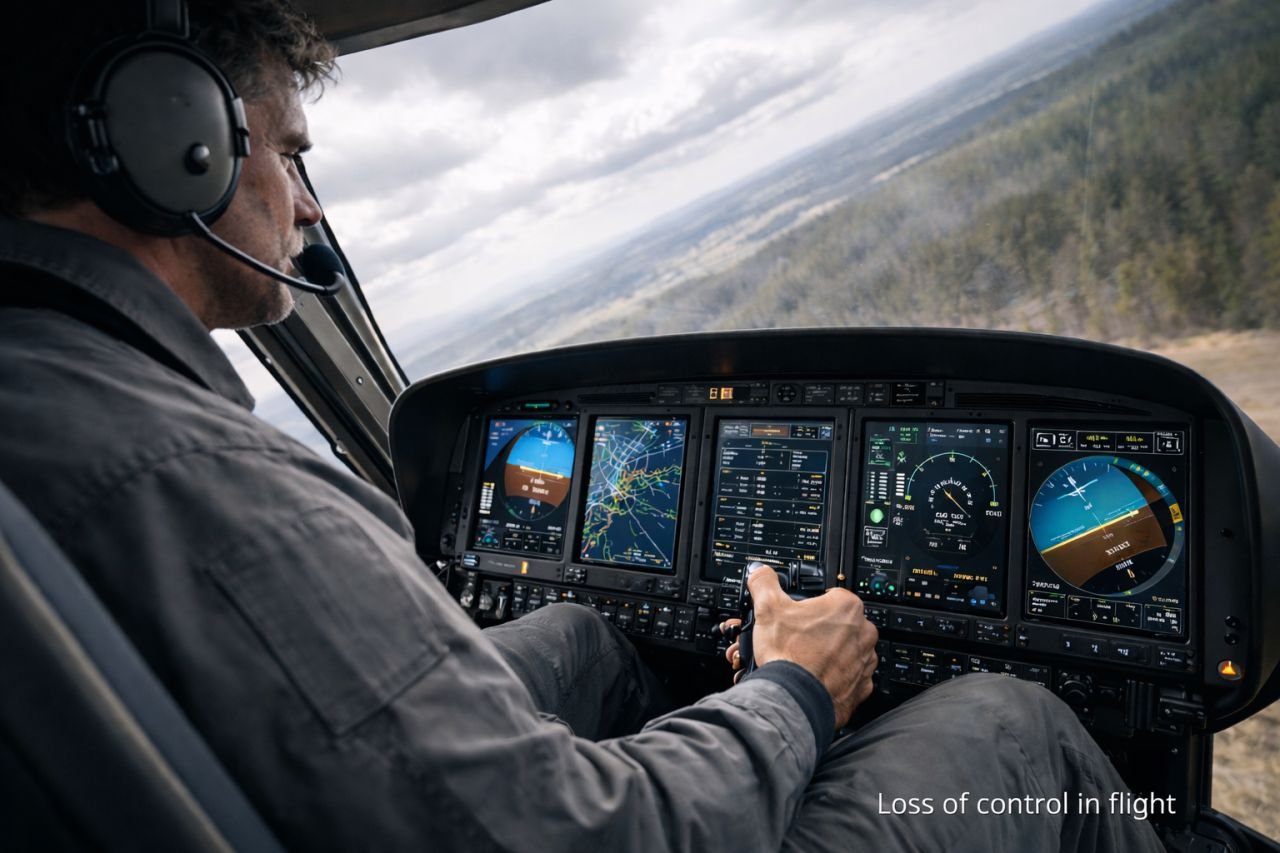
What do you think is the leading accident category in helicopter operations today?
According to the EASA Annual Safety Review 2025, Loss of Control in Flight (LOC-I) remains the most frequent helicopter accident category over the past five years.
What makes this particularly important is that the pattern is not driven primarily by technical failure.
What the data points to
Across LOC-I events, recurring themes include:
- Energy mismanagement — low speed, high power demand, insufficient margins.
- Monitoring weaknesses — not noticing a developing trend in time.
- Spatial disorientation — especially in degraded visual environments, at night or when inadvertently entering cloud.
- Automation handling challenges — mode confusion, or uncertainty when the automation disengages.
How LOC-I develops in helicopters
Loss of control rarely happens as a single sudden event. More often it develops gradually, as the pilot's mental model and the aircraft's real state drift apart. Helicopter-specific scenarios include:
| Scenario | Typical setting | Key protection |
|---|---|---|
| Inadvertent entry into IMC | Pressing on in deteriorating weather | Weather decision-making, early turn-back, IMC recovery training |
| Vortex ring state | Steep, slow approaches with power applied | Approach planning, recognising the onset, recovery technique |
| Loss of tail rotor effectiveness | Low speed, high power, certain wind directions | Wind awareness, power margins, prompt recovery |
| Dynamic rollover | Take-off or landing on slopes, skids pinned | Technique, awareness of lateral cyclic limits |
| Low-level manoeuvring | Low height, low speed, high bank | Energy and obstacle management |
Training has to keep pace
Modern rotorcraft are increasingly sophisticated: glass cockpits, four-axis autopilots, sophisticated flight directors. Yet safety still depends on how effectively pilots:
- interpret the aircraft's state,
- manage the automation (and the transition back to manual control),
- maintain an accurate mental model,
- protect their energy margins.
If LOC-I remains dominant, improving manoeuvre proficiency alone is not enough. We need to reinforce the competencies that protect the human–machine interface: situation awareness, workload management, decision-making and automation management.
Check yourself
Knowledge check
Further reading
- EASA Annual Safety Review (latest edition).
- EASA rotorcraft safety promotion material, including the European Helicopter Safety Team (EHEST) leaflets on topics such as inadvertent IMC, vortex ring state and loss of tail rotor effectiveness.
Keep learning
Try the free course Human Factors Essentials for Pilots, or create an account to follow new articles.